I design enterprise tools, AI-assisted workflows, and decision-support systems. Complex tasks, workflows, and data visualization for agentic systems are where I work best. I take messy, ambiguous workflow problems and shape them from big-picture vision to the design systems that touch the human, business, and technical points.
How I work
My strength
Show me the mess, I find the system.
I take a pile of data, notes and artefacts and find what points to the thing worth building. Give me the mess, or the status quo, and I will find the system, and build it for human engagement. Architecture is where that comes from, and it is why I enjoy the numbers, the maths and the constraints as much as the drawing.
Drag the studio, and step through the process below.
Give me the mess.
Every project starts as a pile. The first move is not design, it is sweeping it into something I can read.
01
The data, inputs, status quo.
Post-its, moodboards, half-ideas, data, screenshots. I do not start organized, and I stopped pretending I do.
02
The clues.
I read the mess like a case. Threads appear between the pieces, and the pattern that says what this is really about starts to show.
03
Three angles at once.
The person, the tech stack, the business. I look from all three so the thing that matters cannot hide behind the thing that is loud.
04
Where the architecture shows.
This is the part I enjoy most, and it comes from architecture: the numbers, the maths, the complexity. Holding several levels of constraint at once, site, structure, budget, the people who will use it, and finding the one plan that satisfies them all.
05
The one thing to solve.
Thinking end to end, the mess points to a single thing worth building, the one that moves the person, the product and the business together.
06
Then I build it.
Down to the micro-technical detail, and built for the person using it, so it does not just demo well. It gets adopted.
Swept into a system.
Read, sorted, and built for the person who uses it. That is the whole strength, and everything else on this site is what it produces.
Background
Before product design I studied architecture, a discipline that taught me to think about how people move through and understand complex environments. That spatial, systems-level thinking helps me translate and build down to the technical level.
I'm a native English speaker and business proficient in German.
Before a screen, there was a site. I learned to design for security and clarity first, so a person could move through a space without second-guessing it. Trust calibration does the same for a model, making its uncertainty safe to act on.
Evidence: ShelfView, HITL Annotations
02/ 04
Human-in-the-loop workflows
A building has to work for the person living in it and the inspector reading its code, at the same time. I learned to design that handoff so neither side had to guess. Human-in-the-loop is that move on a model, deciding where it commits, where it drafts, and where it hands the pen back.
Evidence: HITL Annotations, PPLE
03/ 04
Information architecture at depth
The plan comes before the elevation. One building, organized so a resident and a service route can share it without collision. IA at depth does the same on dense data, structuring one surface for two users with opposite needs.
Evidence: ShelfView, Scandit Express
04/ 04
Design systems at scale
Fifty contractors can build the same building only if the documents are unambiguous. I learned to trust the construction documents. Design systems at scale is that discipline on a product, the standards that keep a whole team consistent without re-deciding everything.
Evidence: Scandit design system, 2025
Architecture to product design
2014 – 2021
Architecture & spatial design
Trained in architecture and landscape architecture, then practised as an architect, regulated, data-dense environments where clarity, trust and long-term consistency are non-negotiable.
2022 – 2025
Scandit: enterprise computer vision & AR
Product Designer across ShelfView, PPLE and Scandit Express: shelf intelligence, AR price execution and activation for Fortune 500 retail clients.
2025 – now
Gysler Designs: independent
Product Designer & Builder. AI-native interaction patterns for enterprise workflows: agentic task flows, LLM output structuring, and human-in-the-loop validation.
Credentials
MSc Architecture
University of Liechtenstein
Vaduz, Liechtenstein
BA Landscape Architecture
University of Georgia
Athens, GA, USA
AI Product Design
UX Certification
Nielsen Norman Group · 2026
Architecture License
LEED Certified · 2014
Languages
English: Native
German: Business (B1–B2)
French: Conversational
Work that does not fit in four case studies
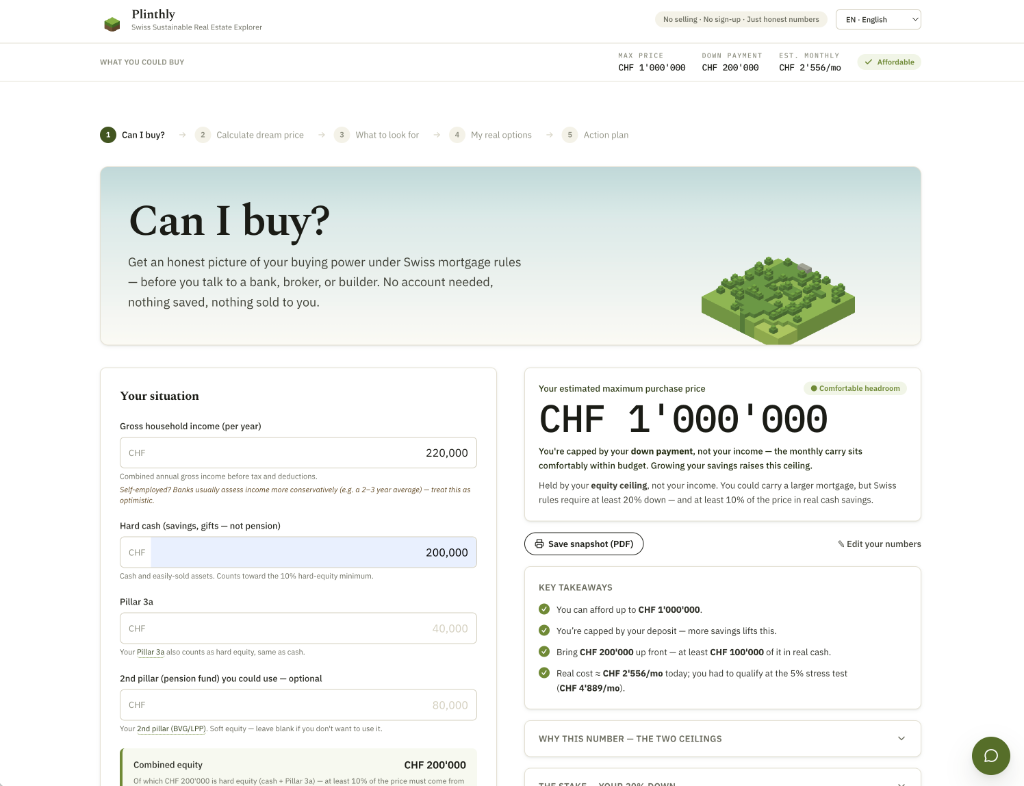
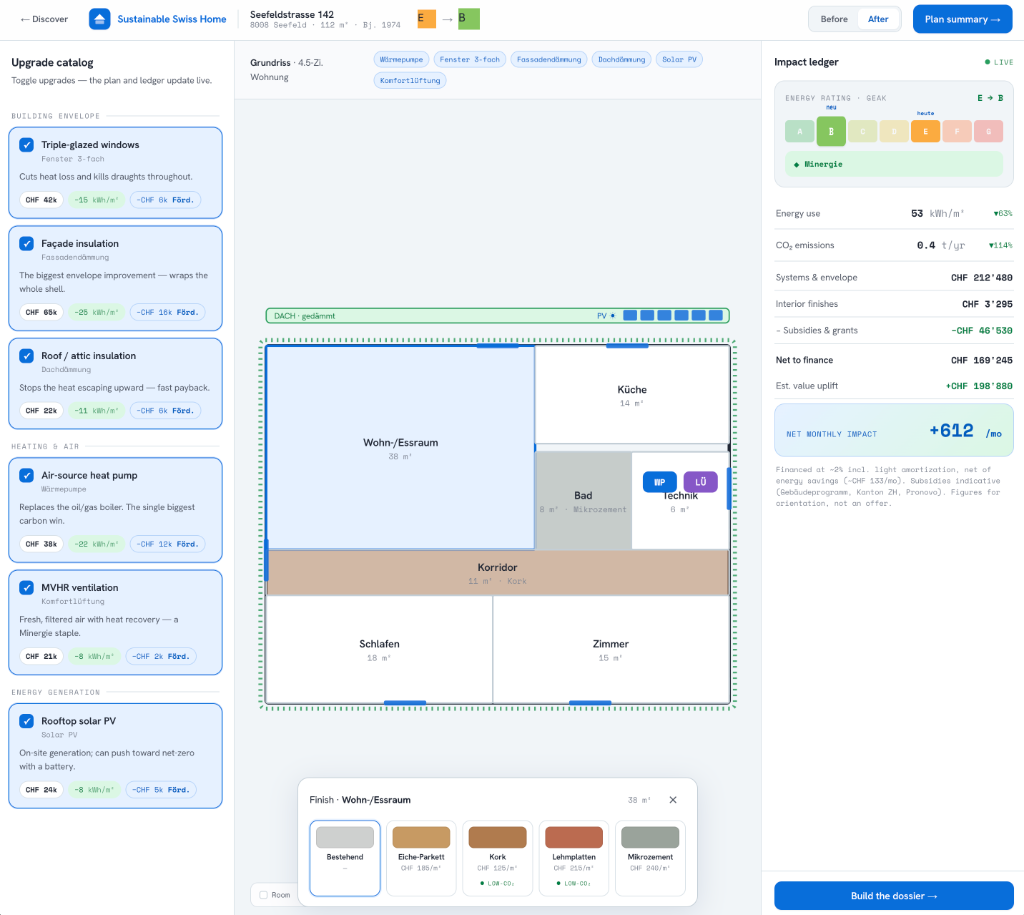
Side projects and explorations live on the Shipped page. They include Plinthly, a mortgage-readiness tool, and earlier concept work across fintech and design tooling.
At any scale, enterprise or a single project, I work from principles down to objects, states and edge cases. The relationships between them exist before a single screen does, so the product holds under pressure instead of just in a demo.
02
I prototype fast, then fine-tune.
Creativity and analytical rigor work together in my hands. I build working interactions quickly to test whether an idea holds, then bring the craft into Figma to refine what survived.
03
I diagnose the gap before the design.
Where uncertainty lives, I look for the space between a business opportunity and a real human problem. Empathy and strategy together decide which gap is worth closing, and how.
04
Humans at the center of the automation.
AI automation only earns its place when people stay inside it. I build empathy, feedback loops and new patterns into the system, so the human is not a fallback but the reason it exists.
$4M+
ARR supported
Design contributions to activation and workflow improvements tied to revenue growth.
56%
Trial conversion increase
Reduced friction in onboarding and clarified setup for new users.
50%
Faster time to insight
Improved information hierarchy so users could identify and act on what mattered sooner.
Enterprise scale
Retail rollout across operations
Designed for complex workflows spanning teams, tools, and real-world constraints.
Metrics shown reflect product or program outcomes from initiatives I contributed to through design leadership, workflow simplification, and interface strategy.